Hospital CSSD Equipment: Boxes, Drums & Complete Process
In modern healthcare, infection control is non-negotiable. The efficiency of a hospital depends heavily on its sterilization backbone, the Central Sterile Services Department. This guide explains Hospital CSSD Equipment, including boxes, drums, carts, and the complete sterilization workflow used in Indian hospitals. Whether you are planning procurement or upgrading infrastructure, this detailed breakdown will help you make informed decisions.
Understanding CSSD in Hospitals and Why It Matters
CSSD in hospitals refers to the Central Sterile Services Department, the unit responsible for cleaning, disinfecting, sterilizing, and distributing medical instruments. Without a properly designed system and reliable Central Sterile Services Department equipment, surgical safety and infection control standards cannot be maintained.
The role of Hospital CSSD Equipment goes beyond sterilization. It ensures:
- Proper segregation of contaminated and sterile zones
- Controlled workflow from decontamination to sterile storage
- Compliance with NABH and international sterilization standards
- Safe handling of surgical instruments
In India, rising surgical volumes and stricter infection control norms have increased demand for durable and high-performance CSSD infrastructure. Hospitals today require robust equipment that withstands high-pressure autoclaving cycles, chemical disinfection exposure, and heavy daily usage.
A properly equipped CSSD reduces hospital-acquired infections (HAIs), protects patients, and improves operational efficiency.
Essential Hospital CSSD Equipment: Boxes, Drums & Carts
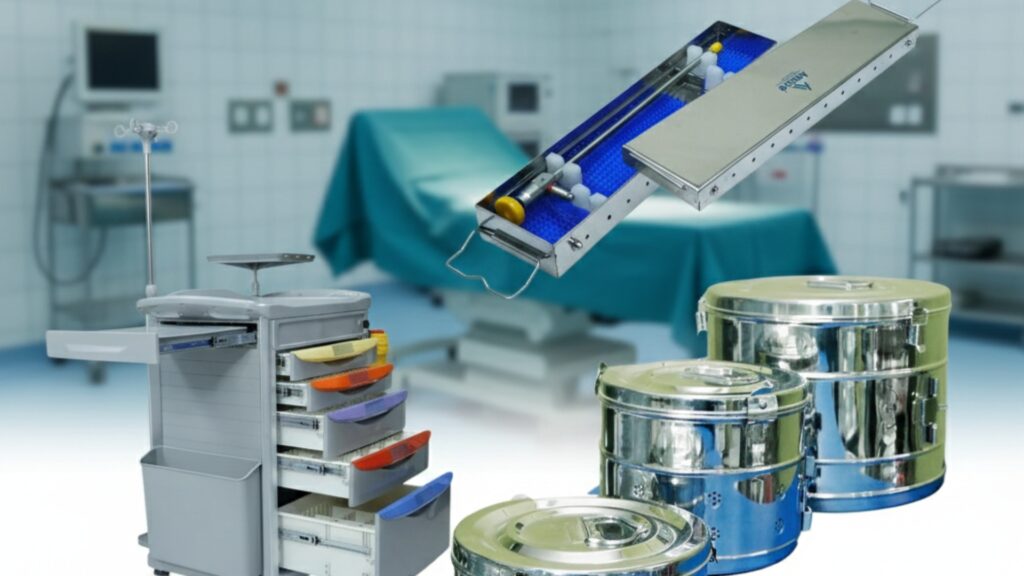
1. CSSD Boxes and Drums
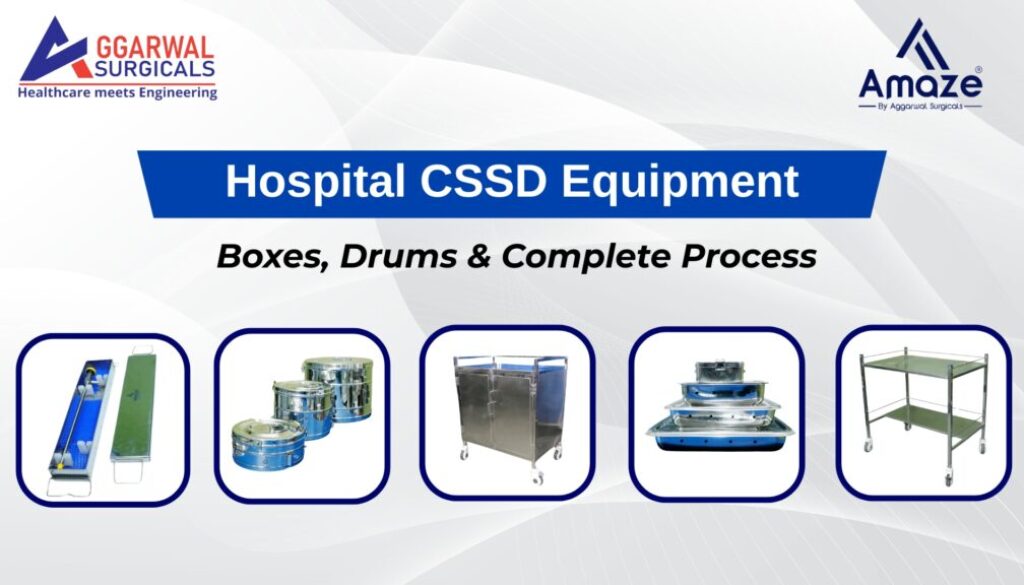
CSSD boxes and drums are used to hold surgical instruments during autoclaving and storage. They are typically made from stainless steel to resist corrosion and maintain structural integrity under high heat and pressure.
Key features include:
- Perforated lids for steam penetration
- Locking systems for contamination control
- Size variations for different surgical sets
- Label holders for traceability
In the hospital sterilization process, instrument trays are loaded into sterilization drums, sealed, and placed inside autoclaves. Properly designed boxes ensure uniform steam distribution, which is critical for effective medical instrument sterilization.
2. CSSD Carts and Trolleys
CSSD carts and trolleys enable safe movement of sterile and contaminated materials between zones. These include:
- Dirty linen trolleys
- Instrument transfer carts
- Sterile supply distribution carts
High-quality Hospital CSSD Equipment ensures smooth mobility, load-bearing strength, and contamination prevention through closed-body designs.
The Complete CSSD Sterilization Workflow Explained
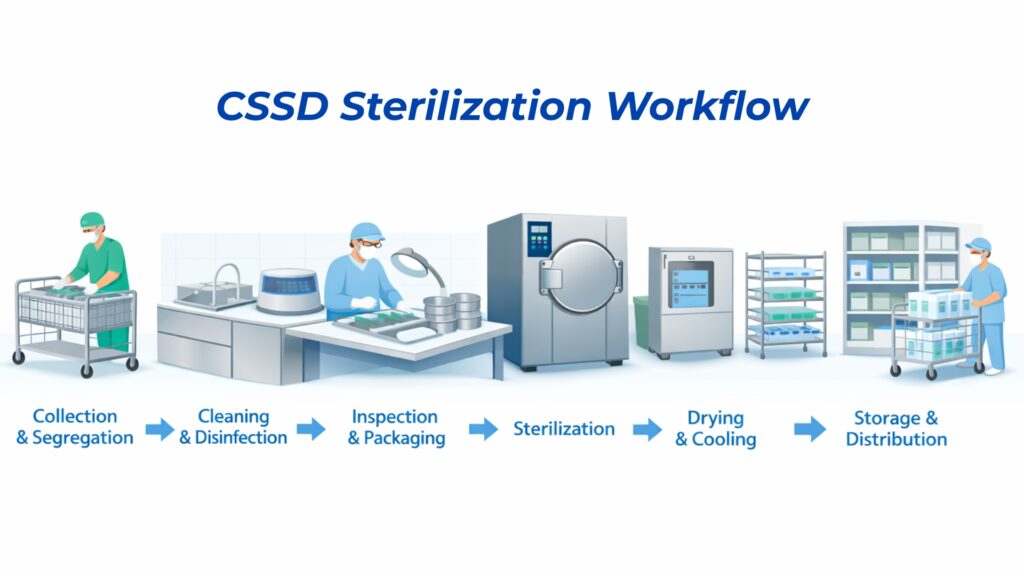
The CSSD sterilization workflow follows a strictly linear process to avoid cross-contamination. A well-planned layout supports this sequence:
Step 1: Collection and Segregation
Used instruments are collected in designated trolleys and transferred to the decontamination area.
Step 2: Cleaning and Disinfection
Manual cleaning, ultrasonic cleaning, and washer-disinfectors remove organic debris before sterilization.
Step 3: Inspection and Packaging
Instruments are inspected for damage, assembled into sets, and packed inside CSSD boxes and drums.
Step 4: Sterilization
Autoclaves, ETO sterilizers, or plasma sterilizers complete the core hospital sterilization process.
Step 5: Drying and Cooling
Sterile items are cooled under controlled conditions.
Step 6: Sterile Storage and Distribution
Sterilized instruments are stored in dedicated sterile storage solutions for hospitals before distribution to OT or wards.
Each stage depends on reliable Hospital CSSD Equipment to maintain sterility assurance levels (SAL).
CSSD Setup Requirements for Indian Hospitals
Planning a CSSD requires careful infrastructure design. Typical CSSD setup requirements include:
- Zonal separation: Dirty, clean, sterile areas
- Pass-through autoclaves
- Stainless steel workstations
- Adequate ventilation and pressure control
- Ergonomic instrument inspection tables
Indian hospitals must comply with NABH guidelines and infection control protocols. The selection of Hospital CSSD Equipment should consider bed strength, surgical volume, and specialty departments.
Durability is crucial in Indian climatic conditions where humidity can affect metal surfaces. Stainless steel grade quality and fabrication standards directly influence longevity and compliance.
Manufacturers like Aggarwal Surgicals design equipment tailored to Indian hospital needs, ensuring structural strength, corrosion resistance, and workflow compatibility.
Comparison: CSSD Boxes vs Drums vs Carts
| Equipment Type | Primary Function | Key Material | Workflow Stage |
| CSSD Boxes | Instrument packaging | SS 304/316 | Pre-sterilization |
| Sterilization Drums | Steam sterilization | Stainless Steel | Sterilization |
| CSSD Carts & Trolleys | Instrument transport | Heavy-gauge SS | Collection & Distribution |
This structured approach ensures traceability, safety, and operational efficiency within Hospital CSSD Equipment systems.
FAQs – Common CSSD Queries.
What is the role of Hospital CSSD Equipment?
It ensures systematic cleaning, sterilization, and safe distribution of surgical instruments while preventing hospital-acquired infections.
What materials are best for CSSD boxes and drums?
Stainless steel, especially medical-grade SS 304 or 316, is preferred due to corrosion resistance and high heat tolerance.
How does the CSSD sterilization workflow prevent infection?
By maintaining strict zone separation and following a unidirectional flow from dirty to sterile areas.
What are the basic CSSD setup requirements?
Separate zones, pass-through sterilizers, stainless steel workstations, proper ventilation, and quality storage systems.
Why Choosing the Right Manufacturer Matters
Selecting trusted suppliers for Hospital CSSD Equipment is critical. Equipment must meet durability standards, support high-volume sterilization cycles, and integrate seamlessly into the hospital sterilization process.
At Aggarwal Surgicals, hospitals across India source reliable CSSD boxes and drums, stainless steel trolleys, and customized Central Sterile Services Department equipment designed for long-term performance.
Proper investment in quality equipment reduces maintenance costs, improves sterilization reliability, and enhances patient safety outcomes.
Final Thoughts
An efficient CSSD is the backbone of infection control. From durable boxes and drums to precision-designed carts and sterile storage systems, every component of Hospital CSSD Equipment plays a vital role in safeguarding patients and healthcare workers. If you are planning a new CSSD setup or upgrading existing infrastructure, partner with experienced manufacturers like Aggarwal Surgicals to ensure compliance, durability, and long-term operational efficiency.
For customized CSSD solutions tailored to Indian hospitals, explore the complete range at Aggarwal Surgicals and build a safer, more reliable sterilization system today.